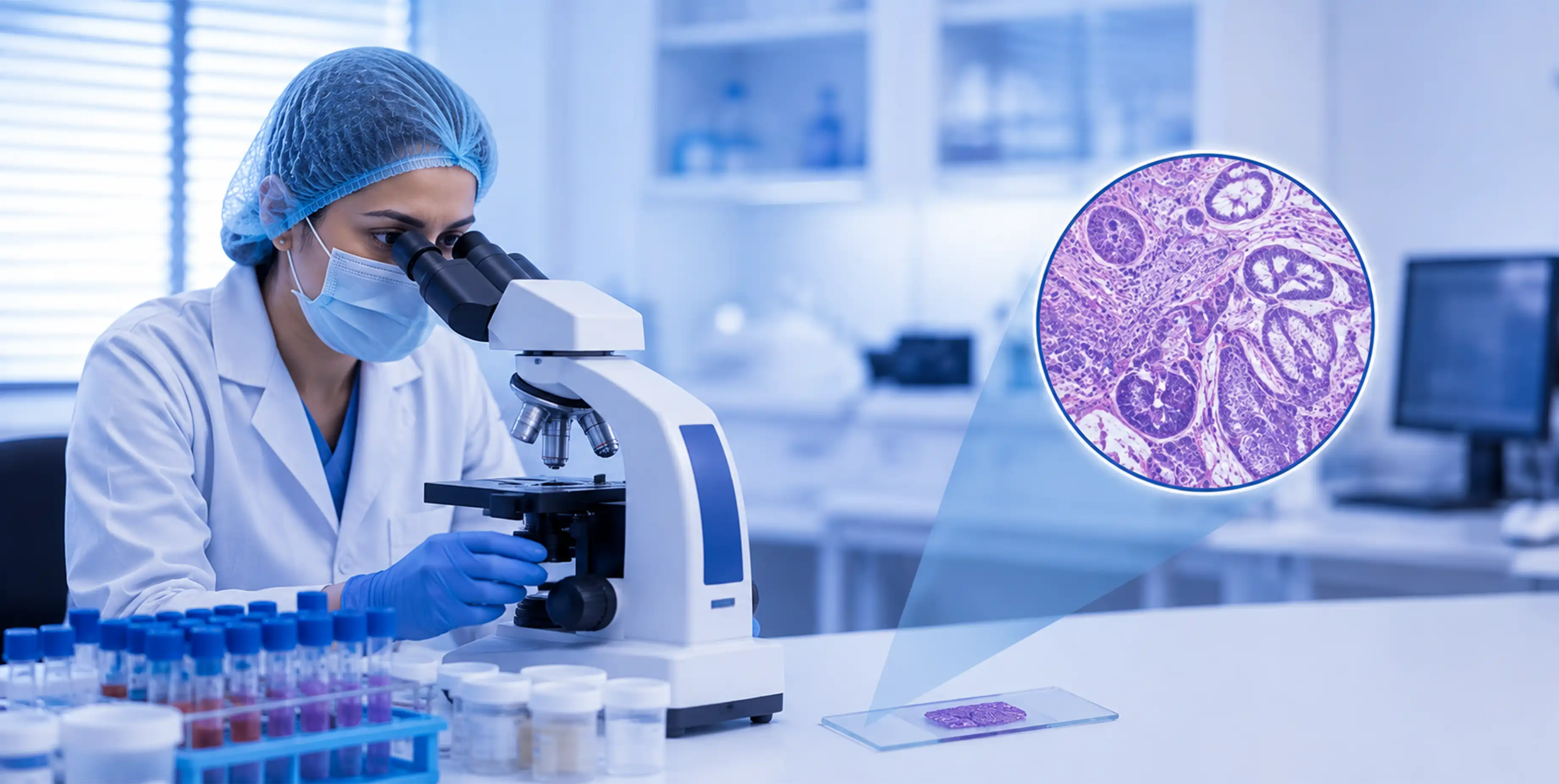
When Should You Get a Histopathology Test? Signs, Procedure, Report & Why Early Diagnosis Matters
A doctor rarely confirms cancer or tissue disease just by looking at a scan. That confirmation usually comes from a histopathology test, a lab process where a pathologist studies your actual tissue cells under a microscope. If your doctor has already asked for one, you're probably wondering what happens next and whether it's something to worry about.
What is Histopathology?
Strip away the jargon, and it's simple, a small sample of tissue, taken via biopsy or during surgery, gets examined cell by cell. A blood test tells you something is off. Histopathology tells you exactly what and where. That's the difference, and it's why doctors lean on it so heavily before deciding on treatment.
Pathologists look at cell morphology and architecture and how the tissue compares to healthy tissue nearby. This level of detail simply isn't available through imaging or blood work up alone. At Holy Family Hospital, the Pathology Department is ISO 9001:2015 certified and takes part in External Quality Assurance Schemes (EQAS), which essentially means the lab's accuracy is checked against outside benchmarks, not just its own internal standards.
Signs Your Doctor Might Order One
There's no single symptom that automatically means "get a histopathology test". But certain patterns tend to push doctors in that direction:
• A lump or swelling that hasn't gone away after several weeks
• Bleeding that shouldn't be happening, especially after menopause
• A mole or skin patch that's clearly changed in shape, size, or colour
• An imaging report that flags something "suspicious" without confirming what it is
• Unexplained weight loss alongside any of the above
If more than one applies, your doctor will likely recommend testing sooner rather than waiting to see if things improve. A mammography test that comes back unclear, for instance, is one of the most common reasons a breast biopsy gets ordered the two tests work as a pair, not as substitutes for each other.
What the Procedure Actually Involves
Here's where a lot of the anxiety comes from people imagine something far more dramatic than it is. A small tissue sample is taken, either with a needle, through an endoscope, or during a surgical procedure already underway. It gets preserved, sliced wafer-thin, stained with dyes that make cell structures visible, and studied under a microscope.
Depending on where the biopsy is taken from, you might feel a pinch or mild pressure. It's rarely described as genuinely painful, though the site can feel tender for a day or two afterwards. Recovery time depends on the biopsy method. Needle biopsies usually need no downtime, while surgical biopsies may need a day or two of rest. If your biopsy is being taken during an endoscopy test, sedation already used for the procedure typically covers the discomfort of the sample collection itself.
Reading a Histopathology Report Without Panicking
Reports usually include a few key elements:
• The type of tissue examined
• A description of what the cells look like under the microscope
• The final diagnosis benign, malignant, or occasionally inconclusive
• A grade, if cancer is confirmed, describing how abnormal the cells appear and how aggressively they might grow
One piece of advice worth repeating: don't try to Google your way through a pathology report. Words like "atypia" sound alarming out of context but often aren't. Ask your doctor to walk you through it line by line instead. At Holy Family Hospital, pathology reports are routed directly to your treating physician, so the person best placed to explain the result is the one reading it with you.
How Accurate is Histopathology?
It's still considered the most reliable way to confirm most tissue diseases, simply because it examines actual cells rather than working backward from symptoms or blood markers. That said, accuracy leans heavily on two things, how the sample was collected and who's reading it under the microscope.
Why the Lab You Choose Matters
This is the part people underestimate. Choosing the best histopathology lab in Bandra, Mumbai, isn't just about convenience, a rushed or poorly stained sample can lead to an unclear report, which then delays whatever treatment you actually need.
At our histopathology hospital in mumbai, samples are handled by an experienced pathology team including Dr. Jude Vaz, and Dr. Sneha Chandwani and reports go straight to your treating doctor so nothing gets lost in translation between departments. If a result does come back suspicious, the hospital's multidisciplinary network of 300+ doctors across 36 specialities means a referral to surgical oncology, gastroenterology, or whichever department is relevant happens within the same building.