Robotic vs Conventional Knee Replacement: What's the Difference?
Overview
Knee replacement used to mean just one thing traditional surgery with standard tools. Now there's a second option, and choosing between them isn't always easy. Robotic vs Conventional Knee Replacement is the question most patients land on once their doctor confirms surgery is the next step, and getting a clear answer matters more than most people realise, especially when it affects both the outcome of the surgery and how quickly you get back to your routine.
Signs Your Knee Pain Needs More Than Home Remedies
Many people try to manage knee pain on their own for way too long with rest, ice, painkillers, and repeat. At some point, that stops being enough, and the pain starts showing up in situations it never used to.
● Pain that shows up every time you walk, stand, or take the stairs
● Morning stiffness that just won't loosen up, even after moving around for a while
● Swelling that keeps coming back no matter what you do
● A grinding or clicking feeling with movement, sometimes loud enough to notice
● The knee starting to look bowed or feel wobbly under weight
● Pain that disturbs sleep or flares up during long journeys
If the list sounds familiar, it's worth getting it looked at properly rather than pushing through another few months hoping it resolves on its own.
What Is the Difference Between Robotic and Traditional Knee Replacement?
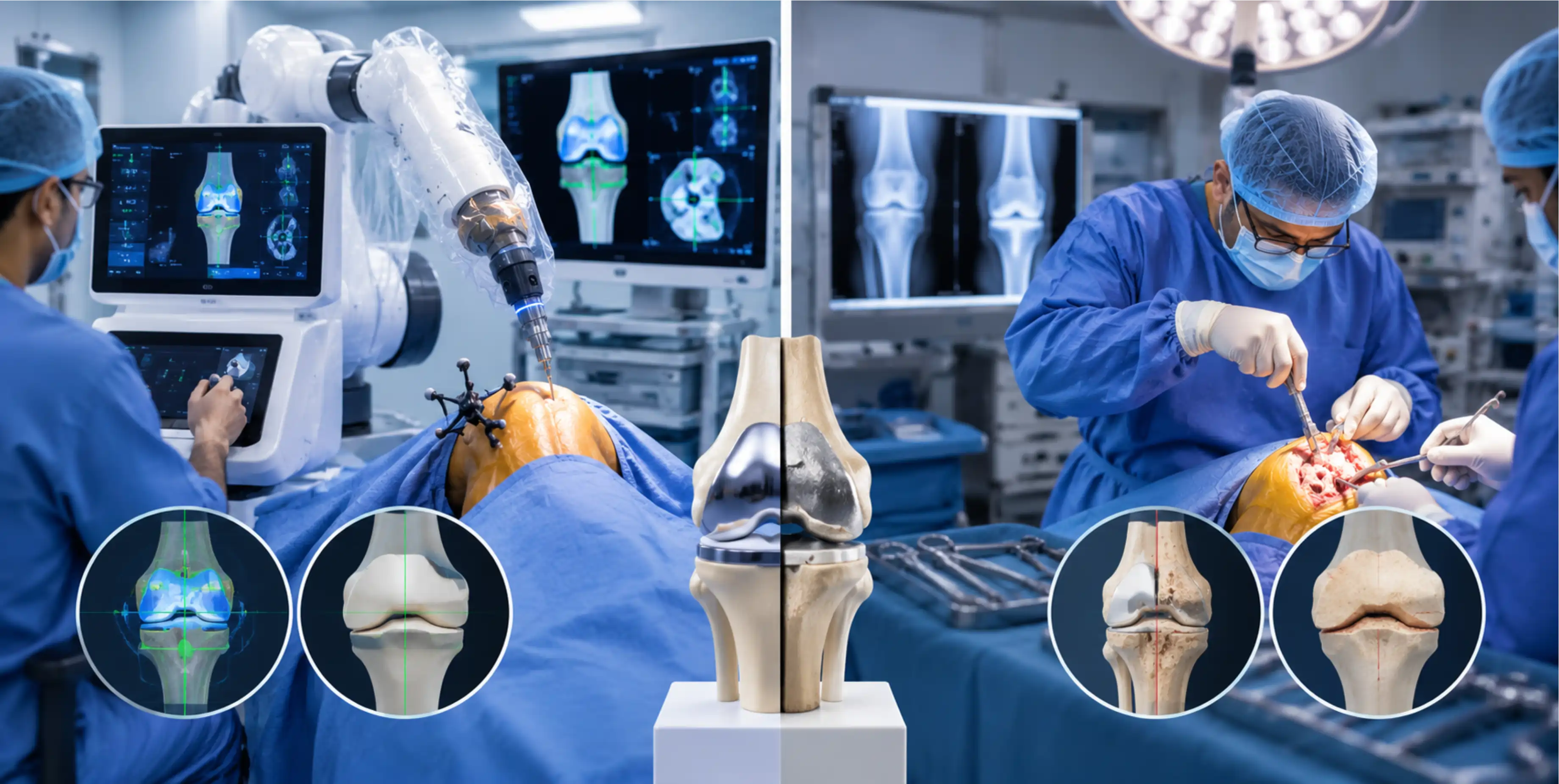
In traditional surgery, the surgeon does everything by hand measuring, cutting, and fitting the implant, all based on training and experience. It's worked for decades and still works fine for plenty of patients, particularly in straightforward cases without much bone deformity.
Robotic knee replacement adds a planning step before the actual cutting begins. Imaging builds a 3D model of your knee, and the robotic arm follows that exact plan during surgery, keeping every cut within very tight limits throughout the procedure.
The gap between the two isn't about who is "better" at surgery. It's about consistency. A robotic system repeats the plan exactly every time, in a way manual technique can't quite match, especially in knees with unusual bone structure or previous injury.
● Robotic imaging maps out bone density and joint angles before surgery starts.
● Implant alignment tends to be more precise with robotic guidance.
● Soft tissue around the joint experiences less disruption during robotic-assisted cuts.
● Traditional surgery still depends heavily on the surgeon's manual judgement.
● Both approaches use the same implant materials, only the placement technique differs
Which Knee Replacement Surgery Has Faster Recovery?
This is honestly the question that most patients care about. The answer depends on the individual, but robotic surgery usually has an edge in most comparisons.
● Smaller incisions mean less trauma to surrounding tissue.
● Less tissue damage usually translates to less pain right after surgery.
● Robotic patients often start walking sooner than traditional surgery patients.
● Physiotherapy in the first six weeks plays a bigger role in recovery than the surgery itself.
● Sticking to wound care and medication instructions is non-negotiable during this period.
● Light daily activity usually resumes in four to six weeks either way, with full recovery taking a bit longer depending on age and overall health.
Where to Get It Done in Mumbai
At Holy Family Hospital, Bandra West, Mumbai, the orthopaedics team doesn't push straight to surgery proper diagnostics come first, so you're only in the OT if it's genuinely necessary. This kind of structured evaluation matters, since not every case of knee pain needs surgical intervention right away.
The hospital has been in Bandra for over 80 years, with an experienced orthopaedic team specialising in joint replacement and advanced robotic-assisted and computer-guided techniques. With a strong surgical track record and comprehensive rehabilitation support, it is worth considering when evaluating options for the Best Robotic Knee Replacement hospital in Mumbai.
Conclusion
Honestly, there's no clear winner between the two techniques on paper. It really depends on your knee condition, what your surgeon recommends, and how seriously you take recovery afterward. Robotic surgery does offer more precision, and for many patients that means returning to normal life sooner, but a skilled surgeon using the traditional method can still achieve excellent results. For Robotic Knee Replacement surgery in Mumbai, you can get in touch with the orthopaedics team at Holy Family Hospital on St Andrew's Road, Bandra (West), Mumbai 400050, or just call 022-6267 0366 to book a consultation and figure out which approach makes sense for you.